Showing posts with label libraries. Show all posts

Tuesday, May 17, 2011

The Library As a Place

In case you missed it, I'm attending the Medical Library Association conference in Minneapolis this week.  I've been chosen as an official conference blogger and will be blogged a couple of times a day on my experiences as a new member and first time conference attendee.  I know most of you won't be following me on the official conference blog, so I will be reposting my posts here.


It seems an unofficial theme of "the library as a place" is going around.  From T. Scott Plutchak's Janet Doe lecture today to talking to librarians who round at lunch yesterday to talk of closing the reference desk at the Rethinking Libraries in Hard Times session this afternoon, everyone seems to be saying the library as a physical space doesn't exist anymore.  Or shouldn't exist or can't exist depending on who you talk to.  This is not an uncommon idea in any sort of library circles and an argument we've all been hearing for quite some time.


But what I haven't heard much talk about (in sessions or just in conversation) is a defense of the library as a space.  Arguments from those of us who have active, vital physical libraries.  So I'm here to take up the banner, at least for my own library.


The majority of my library users are residents and attending physicians.  Some do their own searching, some don't.  Some only use UpToDate to answer clinical questions, some prefer me to do a quick search.  Some like their articles hand delivered to their office, some will only accept them via email.  But they all have one thing in common: they like to pop by and ask me questions.  I have very few users whom I have never seen personally, and those that I haven't, it's because their practice is outside the hospital.


My library has a steady stream of visitors all day.  Surgical residents who drop by to take a look at an atlas, faculty members who come by with research questions, busy clinicians who use what little free time they have to peruse the latest copy of a print journal.  The common thread here is that they are visiting a physical space with physical resources and working with me, live and in person.


I'm rarely out of the office because I don't know when I'll be called upon to help answer a question or locate a resource.  The library itself is open 24 hours a day and stats show that it is used 24 hours a day.  And by the number of books scattered around in the mornings, they aren't coming in to use the computers.
So in my hospital the physical library is necessary.  I'm sure, after an adjustment period (probably full of complaining docs), we could move to a virtual library and I could roam the halls providing library services to those in need.  But this model works for my hospital and my patrons.  So I am defending (and will continue to do so) the library as a place in my institution.


Debate time: what are your thoughts on the matter?  Could you move to a mostly virtual library?  Have you already done so?

Thursday, March 10, 2011

A Little Bit of This and a Little Bit of That

I don’t really have enough for a full blog post today, so I thought I would just through a few thoughts out here today.

In Need of Lunch Ideas
Yesterday I told you how I’m giving up meat for Lent.  Originally, I was mainly concerned about having difficulty going out to dinner and finding vegetarian options on the menu, but, when I was packing my lunch this morning, I realized how much I depend on meat for lunch.  I usually try to eat leftovers for lunch, but when I’m out of those (like today), I usually eat turkey sandwiches, frozen dinners, or soup.  The only vegetarian lunch options I could think of (besides leftovers) were peanut butter and jelly sandwiches and vegetarian soups.  I need some suggestions for lunches that can be easily and quickly packed and taken to work.  Any ideas?

Writing Cover Letters
I’ve been trying to write a post about drafting a good cover letter and failing miserably.  My cover letters were well written, but it’s been so long since I’ve written one that I’m having trouble coming up with good ways to explain it.  If anyone has any ideas, suggestions, or resources on writing cover letters for library jobs , I would appreciate it!

Boycotting Harper Collins
Have you been keeping up with the “Boycott Harper Collins” movement?  I have, but rather sporadically, mainly through Agnostic Maybe.  While I like the idea of a boycott, I wonder how much of an impact it’s really going to have.  Yes, libraries have a lot of purchasing power, but when compared to the rest of the country and all the bookstores purchasing Harper Collins books, libraries are chump change.  I sincerely hate the restrictions the publisher is putting on libraries, but I’m not sure that a boycott is truly the most effective way to make our voices heard.  But I also don’t have any better ideas.    

Medical Library Association Annual Conference
In case you missed it on Twitter, I’m an official conference blogger for the Medical Library Association’s Annual Meeting in Minneapolis in May.  I will be blogging twice a day on the official conference blog about what’s it is like being a new member participating in my first conference.  The conference runs May 13-18 and I will be sharing several of my posts here too so you can keep up with what I’m doing.

Speaking of Conferences
I’m also attending the American Library Association’s annual conference in New Orleans in June.  If you’re going to be there, let me know and we can try to meet up!  But the really exciting part is that I’ve been asked to be part of a panel on management, new librarians, and new managers.  The discussion panel, which is hosted by the Emerging Trends Discussion Group in the Human Resources section of the Library Leadership and Management Association, will be on Saturday, June 25.  I’ll share more details including time and specific location when I have them.  But if you are going to be at conference you should totally come and watch me attempt to public speak.  It should be highly entertaining!  

And just because...
…I love to show her off, here are two pictures of Caty being exceptionally cute.  


Thursday, February 24, 2011

A Thursday Library Rant


Have you entered my “blog-a-versary” giveaway yet?  It ends on Friday!!

Note: I started this rant on today’s open thread at Agnostic, Maybe and I’m finishing it up here. 

There has been SO. MUCH. TALK. about technology training in library school, and while that is so great and wonderful and necessary for some jobs, it is not necessary for mine.

I'm a solo hospital librarian working at a not-for-profit, community-based, teaching hospital.  My main users are residents and attending physicians, but I also work with nurses, pharmacists, and administration.  I spend my days doing literature searches, finding and sending articles, maintaining my collection, helping out with research and grant writing, and teaching instruction classes.  I do classic library work.  My job description and my actual duties (as they sometimes - er, always - differ) have nothing to do with programming, web design (in fact I'm not even allowed to touch the website), or anything tech related past putting paper in the copier and turning on and off my computer. 

If I had been required to take a lot of technology classes for my MLIS, I would have of course done so and probably been a more well-rounded librarian, but at this point in my career it would have been a complete waste of time.  I may need it for a future job, but let's face it, by the time I move on, things will have already changed so much that what I learned in school would be useless.

The skills I need for my job are good reference skills, cataloging/indexing (although most of what I do is copy cataloging, knowing how NLM indexes articles for PubMed is so helpful), and customer service skills. 

Which actually brings me a really great point.  Customer service skills and how incredibly important they are. 

I’ve said before that my job is 1/3 library skills and 2/3 people skills.  I can teach anyone (well, anyone with a good head on their shoulders and a desire to learn) how to do library work.  But I can’t teach anyone how to be a librarian.  Because being a librarian isn’t about doing library work.  Being a librarian is about being a service professional.  You are providing a service to your users/patrons/customers/whatever you call them.  And your users/patrons/customers/whatever are people.  And if you don’t like people then why do you want to be a librarian?

People use libraries and librarians help these people.  So it would make sense that librarians should actually like and be good with people, right? 

Apparently that's not always the case.

I was reading a blog post the other day (now I can’t remember where so if you know, please put the link in the comments) about how shocked someone was when people were sharing, on that first day of library school (you know where you have to stand up and say why you’re there), that they went to library school because they like to read and/or because they like books. 

Getting back to my original point (I had one someone), these are the kind of people we should be concerned about going to library school.  Not people who are technologically-illiterate, but people who don’t know what it means to be a librarian.  (Side note: read this comment for a great idea on how to fix this problem.) Because being a librarian is not about liking books or programming or being great at twitter.  Those are all great qualities, but what makes a good librarian is someone who is helpful, who is genuinely interesting in assisting and teaching users how best to access their information, and who actually likes working with people.   

Unless you are a cataloger or in IT; then you can sit in your office and do whatever you want to do, however you want to do it, because, let’s face it, we need you desperately.

That’s the end of my rant.  Thoughts?

Tuesday, January 25, 2011

Library Day in the Life

Every so often, us librarians get bored and like to share our (super exciting) days with other librarians. It's called Library Day in the Life and it happens about twice a year. I shared my day with you this past summer, and I'm sharing what my yesterday was like with you again now.

Yesterday was actually a very non-typical day for me because I was at our sister library helping with a project. I'm actually glad that we scheduled our project for yesterday because it gives me the opportunity to share a difference side of librarianship from the day-to-day reference and management stuff.

So, in chronological order, here is how my day went:

8:30 – arrive at the library, chat with the librarian there, catch up on our weekends, the latest gossip, etc (we're friends which makes working together so much easier).

8:45 – Greet our library assistant (she goes back and forth between libraries) and we go over the plan for the day

9:00 – Check my own email, facebook, and twitter. Realize it's #libday6 and what a great day it is for that. So naturally I tweet about it. Our boss comes in with some news and inquires about our project.

9:15 – The library's phone starts ringing and suddenly we all have work to do. I print out a few of the ILL articles that came in over the weekend and put them in the doctor's box for her to pick up later.

9:30 – The other librarian gives me a list of citations to confirm, which I do and then I print and/or order the articles. The phone rings again with yet another search and two more doctors make appearances with requests.

9:45 – I wonder if we are ever going to get started on our project or if we are going to be busy with reference work all day

10:00 – I reach into my librarian's bag of tricks and find some articles for a doctor on seasonal affective disorder. She's given a talk about it (on TV!!) today and she forgot to ask for research help later. Grr…I hate when they wait until the last minute. I give the citations I find to our assistant to track down.

10:30 – My colleague is still working on several other searches, so I go ahead and get started on our weeding project. Her journal collection is quickly overwhelming her space so we need to decide what needs to go and what stays. Unfortunately, our catalog isn't the best kept up (thanks to the former overworked librarian, us being overworked, and just not wanting to deal with it), so we can't just print out a shelf list and go from there. I start at the beginning of the alphabet and work my way through the stacks, noting the title and the date ranges on my trusty notepad. I run back and forth to the computer to check what I have in my library (we did this same project last spring so my part of the catalog is up to date – the journal part at least. The books leave a lot to be desired.). At this point, I wish out loud for an iPad. My colleague begins checking grant options to see if we can get one.

11:45 – The other librarian finishes up her work and starts working with me to make it through the journal collection. It's slow going.

12:00 – We break for lunch and I'm reminded yet again how this hospital's food is so much better (and cheaper!) than mine.

1:15 – We are slow to get back to work, but we do. We finish going through the shelves.

2:00 – It's time to make some decisions. We use the catalog and our statistics to decide what needs to go and we come up with a good sized list.

2:45 – We move on to discussing the budget, what journals to buy, what to cut (we have to make a 2% cut this year), how we are going to pay for the MLA conference, and discuss a few new products we want to try. We are really interested in eBooks, but no ideas on whether or not they will get used and should we spend the money? Money. It always circles back to money.

3:45 – The other librarian goes back to work on some more searches while I type up a list of what is to be discarded because I'm the only person who can read my handwriting. Oops. I also type up some different cut/keep options with prices to see how much money she can save.

4:40 – It's finally time to go. I'm exhausted.

Clearly, this wasn't an ordinary day since I wasn't in my own library and we worked on some not-every day projects. Collection maintenance isn't my favorite part of the job; I would much rather develop the collection than make cuts, but it's a huge part of ours. We both have such small spaces to work with so we have to make the best decisions possible for our librarians, our users, and our budgets. Making cuts and throwing things away isn't glamorous, but someone's got to do it.

What do you think about my day? Did you learn anything? If you're a librarian, how does my day differ from yours?

Thursday, January 13, 2011

Things I'm Complaining About Today


Sometimes, on twitter (you follow me right?), I list random things that are irritating me today.  But today, I had more to say so I thought that I would list them for you here. 

Because I know you are all so interested in what makes me tick. 

1.      My crappy computer at home.  I have a lovely computer, really I do.  It’s a Dell, purchased in January of 2008 and I’ve only ever had one major hardware problem with it.  So what’s the problem?  It runs on Windows Vista.  And, in case you haven’t heard, Windows Vista is probably the worst operating system ever created.  It slows my computer down so much; even gmail has trouble opening on occasion.  I’ve done everything anyone has suggested to me to help speed it up or make it work better but no such luck.  I’m contemplating getting upgrading to Windows 7.  Thoughts?
2.      Doctors who borrow library books without checking them out.  I know disappearing books is a common problem in any library, but when your collection is only 600ish books, it becomes really noticeable.  Example: a few months ago I ordered this great, newly published book on obesity surgery.  I was very excited to show one of the attending surgeons the book (and its accompanying DVD) and when I went to get it, it was missing from the shelf.  So I checked my circulation system and the stack of cards the patrons sign to check out a book (welcome to a poor library where automated circulation is never going to happen), and no one had checked it out.  Yet the book was missing.  Insert major frustration here.  Any special librarians have any idea on how to prevent this?
3.      Vendors.  Vendors who call when I don’t have time/could care less about the product.  Vendors who don’t return phone calls.  Vendors who show up without notice to pitch something.  Really, just vendors in general.
4.      The fact the BCS trophy is making another round through Alabama Wal-Marts.  I know it’s probably the best place for people to see it and yes, I did stand in line at the Tuscaloosa Wal-Mart last year to see it (don’t judge me), but really?  Wal-Mart?  They couldn’t have found someplace else a little better to show it off?  Thanks for making our state look so awesome.  Again.
5.      Having food waste.  I know my food waste Friday photo for tomorrow is going to be epic and I haven’t even cleaned out my fridge.  It’s hard eliminating food waste without my dad there to eat everything just before it goes bad.

So that ends my complaining session for the day.  How is your day?  Do you have a list of things to complain about?

Wednesday, December 22, 2010

My Guide to Job Hunting: Find Mentors and Maintain Relationships with Them

As I mentioned before, I'm so sorry to ignore any readers who have come here looking for advice and sympathies on being an unemployed librarian.  So I’ve prepared a series of posts to help guide you down your path of library job hunting. Be sure to check out my other posts in this series, Treat Job Hunting Like Your Job, Get Organized, Diversify Your Sources, and Update Your Cover Letter and Resume Daily.

Find mentors and maintain relationships with them
I’ve mentioned several times that I have wonderful mentors and that they served as excellent beacons of advice during my job applying days.  Have I mentioned that the sole reason I’m in the job I’m in now is because of my mentor? 

In late February, I responded to a post on my school’s listserv from a former professor of mine who was looking for some help with a consulting project she was working on a local hospital library.  I knew I didn’t want to be a medical librarian (ha!), but I needed the experience and the money, so I emailed her and told her I was interested.  Fast forward 3 months and I was interviewing for the medical librarian position.  All because of one of my mentors.  Several people had responded to the listserv posting, but she asked me (and my hospital librarian colleague) because she knew me and knew my work. 

Besides my special library mentor, my other mentors were my favorite professor, the director of my program (I was her grad/teaching assistant), and the librarian at the small library on campus where I was a graduate student employee for a year.  All them proofed my resume and cover letters multiple times, gave me interview tips, helped me through my nerves, and gave me countless hours of advice for job hunting and actually being a librarian.  They served as my references, and because I had such good relationships with them, I never worried that one of them wouldn’t show me in the best light.  I kept them informed of my progress and sought their opinions on numerous occasions. 

I still maintain those relationships.  Whenever I visit my library school’s campus, I make a point to try to schedule a quick meeting or a lunch and we have fairly regular correspondence by email.  By maintaining these relationships, I now count them as colleagues and look forward to discussing our jobs and trading anecdotes.  My relationship with my special library mentor is even better.  She stops by the hospital on occasion, we have lunch every few months or so, and she is my biggest source of help.  Whenever I have a question or a literature search that is extremely difficult, I turn to her first. 

I encourage you to find mentors at library school, your job, your local public library, anywhere!  You never know where a good mentor is going to appear.  Mentors should be more than sources for references and job advice.  They should be professional colleagues, even friends.  Someone to guide you on your path to being a better librarian and someone to help you through those tough moments. 

Do you have a mentor?  While I may not be the most experience librarian, I’m always willing to talk to aspiring and new librarians, so feel free to email me with questions or even just to chat.  My email is lizy1285 (at) gmail (dot) com. 

I hope you enjoyed this series.  Please feel free to leave comments or email me with any questions.  If there is a topic I missed or something you would like to see covered, please let me know!

Tuesday, December 21, 2010

My Guide to Job Hunting: Update Your Cover Letter and Resume Daily

As I mentioned before, I'm so sorry to ignore any readers who have come here looking for advice and sympathies on being an unemployed librarian.  So I’ve prepared a series of posts to help guide you down your path of library job hunting. Be sure to check out my other posts in this series, Treat Job Hunting Like Your Job, Get Organized, and Diversify Your Sources.

Update your cover letter and resume daily 
It goes without saying (but I’m going to say it anyway!) that you should tailor your cover letter for each job you apply for.  Not only should you make sure you have the correct name, address, and job title in the letter, but you should also be using the job description to write your letter.  If the job description asks for energetic, enthusiastic librarians with Web 2.0 skills and outreach experience, your cover letter should demonstrate how you meet these qualifications.  The point of a cover letter is to highlight your resume and make you stand out in a crowd.  A cover letter is not the time to be modest!  Outside of an interview, this is your only opportunity to let the search committee know how amazingly suited you are for the job.  And all of it should be done in one page.  That’s a lot to ask I know, but a good cover letter can mean (and mostly likely will) getting the interview over another candidate.  Look for a post on writing good cover letters soon.

A lot of job searchers craft their resume, have a friend or colleague proofread it, and call it day.  That is not enough!  You should tweak, fix, edit, proof, etc your resume every day.  Working on your resume is a great thing to do during the time you’ve set aside each day for job hunting, especially if it’s a day with no applications to complete.  There are a number of resume writing resources out there, so I’m not going to spend time telling you what should and shouldn’t be on your resume.  Hopefully, you should know that.  And if you don’t, email me and we’ll work on it.

A resume is a lot like a cover letter.  It should highlight your abilities, skills, and education.  It should make you look like a star applicant.  While it should never lie or stretch the truth, your resume should make you look like a rock star.  Your resume should show the search committee that you have the education, experience, and skills to do the job they want you to do.  Which is why you should tailor your resume to suit the job.  I’m not saying you should rewrite your resume for every job you apply for, but you should have several different versions.  For example, I had a version for academic libraries with an instruction focus, academic libraries with an outreach focus, for public libraries, etc.  They all had basically the same information on it, but I would move different things towards the top of my list, or add more or less details on certain jobs or skills depending on the type of job and the description. 

Example: Say I’m fresh out of library school and applying for a reference and instruction position at a small academic library.  The first thing I would list is my reference internship and I would give details that emphasized the time I spent sitting at the desk, assisting with instruction classes, and building LibGuides.  I would then progress down my list spotlighting any true reference work and any teaching experience.  Second example: This job application is for a public library reference position.  The first thing I would list would be my internship, but I would change the description to focus more on the reference side and dealing with all types of patrons.  I would also mention something about working with collection development if that was part of the job description.  The next job I would list would be my job as a manager in a bookstore because there I worked with the public, managed employees, did training, etc.  See what I’m doing here?  Your resume should read like a work history yes, but it should also state why your previous experience makes you such a good candidate for this job. 

Coming Wednesday: Find mentors and maintain relationships with them

When was the last time you updated your resume?  Do you write a new cover letter for every job?

Monday, December 20, 2010

My Guide to Job Hunting: Diversify Your Sources

As I mentioned before, I'm so sorry to ignore any readers who have come here looking for advice and sympathies on being an unemployed librarian.  So I’ve prepared a series of posts to help guide you down your path of library job hunting. If you missed anything, check out part one, treat job hunting like your job, and part two, get organized

Diversify your sources
I’ve posted about my top 5 job sites (or sources), but obviously there are others.  The source I used the most and found to be the most helpful was the University of Texas’s iSchool Job Board.  I got the emails (actually I still do) and printed out every job that looked like something I would be interested in.  Other sources that I used, besides the ones on the list, include LibGig, the LIBJOBS listserv (run by IFLA), LibJobs.com, Library Journal JobZone, Higher Ed Jobs, and LISJobs.

The reason I subscribed and checked so many sources is because not every job gets posted all over the internet.  For example, all of the jobs on ALA’s JobList will end up in a Texas iSchool email, but not the other way around.  My job as a medical librarian at a community hospital was posted in our local paper (a great source for corporate/special libraries where the people doing the hiring aren’t librarians), and then later, on LibGig and MEDLIB, but not on any other site.  So even though you may be seeing a lot of the same jobs being posted, you never know when you are going to run across something unique. 

It’s also a good idea to check with local libraries.  The branch libraries in my city have been hiring, but the jobs don’t get posted to national lists.  They occasionally end up on the local library school listserv, but the posting is mainly confined to the library’s web page.  So if you are interested in working in a specific area, check out the libraries’ web sites.  The same goes for academic institutions, especially small and community colleges.

Coming Tuesday: Update your Resume and Cover Letter

What sources am I missing?  What are your favorite sites to look for jobs?

Friday, December 17, 2010

My Guide to Job Hunting: Get Organized

As I mentioned before, I'm so sorry to ignore any readers who have come here looking for advice and sympathies on being an unemployed librarian.  So I’ve prepared a series of posts to help guide you down your path of library job hunting. If you missed part one, you can find it here.


Get organized
I can be very organized and compulsive when it comes to certain areas of my life, and job hunting was definitely one of them.  I work better with a set schedule, to-do list, and deadline so I set up the process described above to suit my personal needs.  Obviously, most of you aren’t as obsessive as I am, so you’ll want to set your schedule up to suit your needs. 

I established three ways of keeping track of the paperwork job hunting generates.  The first was a job hunting binder to help me keep track of all the job postings I came across.  I used a 2 inch three ring binder and 4 dividers, labeled according to job type: academic, public, special, applied for.  I printed off every posting I found that I thought I might possibly apply for (I know, a huge waste of paper, but necessary for me), and wrote the application date on it.  I then highlighted the date according to priority (immediate, open until filled) and arranged them in the binder in the correct category, according to their priority level.  After I applied for the job, I wrote the date I applied at the top and stored it in the last section “applied for”, organized by date.  When I followed up on the a job or heard back from the job in any way, I also marked that on the job description. 

The second way I stayed organized was by establishing a flash drive just for job hunting purposes.  I only stored job-related documents on the drive.  That way I could carry it around and use it on different computers without having to email myself all sorts of documents.  On that drive is the cover letter for every job I applied to, and probably 5 or 6 different versions of my resume (another post coming soon to explain why I think you need multiple versions of your resume).  I saved all working files as word documents and finished documents (ones that had been attached to a job application) in a PDF.  Now, I’m a little obsessed with folders on a drive so I had folders that mimicked the sections in my binder.  I found that helpful because when I was following up or needed to reference something, I could easily locate the correct cover letter/resume.  I know a lot of people don’t save all their cover letters and may find this excessive, but again, this is what worked for me and kept me sane through all of this.

The third and last way I maintained organization was an Excel spreadsheet.  I know next to nothing about Excel, but I am capable of setting up a simple spreadsheet to help me keep track of all the jobs I applied to.  I liked to think of the binder as way to keep track of all the job postings for jobs I wanted to apply for and the spreadsheet to keep track of all the jobs I applied for.  My headings were simple and included things like the name of the institution, what sort of place it was (public, academic, special), where the job was, what kind of librarian they were looking for, the date of the application deadline AND the date I applied, whether it was an electronic application, an email application, or a print and mail one, if I had followed up, the date of the follow up, if I had received any correspondence from the library and what kind, and if I received a phone or in-person interview.  Obviously, this was a huge spreadsheet, so I never printed it out, but I used it to keep track of how my job application was progressing.

Coming Monday: Diversify Your Sources

How do you stay organized in your job hunting?  Is my method to OCD for you? :)

Thursday, December 16, 2010

My Guide to Job Hunting: Treat Job Hunting Like Your Job

As I mentioned before, I'm so sorry to ignore any readers who have come here looking for advice and sympathies on being an unemployed librarian.  So I’ve prepared a series of posts to help guide you down your path of library job hunting. 

Even before my 5 month stint as an unemployed librarian, I was a serious job hunter.  I started job hunting the September before I graduated library school in December.  So I easily clocked in at 8 months of serious job hunting before I lucked out with my current job.  Thus, I consider myself fairly experienced in the realm of library job hunting.  I am by no means an expert, so this serves as a disclaimer that what worked for me may not work for you.  But I hope it at least helps. 

Somewhere along the line (sometime before graduation) I developed a daily routine or a process for job hunting.  I had several mentors in library school, ranging from professors to practicing librarians to the director of my program, and all of them provided me with job hunting advice and taught me great skills.  I sort of meshed all these skills together and created my own process/routine/guideline/whatever you want to call it.  There are five parts in my process, and beginning today, I will share this guide with you.

Treat job hunting like your job
One of the best pieces of advice I ever got before library school graduation was treat job hunting like a job.  What my awesome mentor meant by that was you should set aside time every day to job hunt; create a work-like environment (see “get organized” below) and sit down and do nothing but job hunt.  Go somewhere else other than your home if you need to further that “going to work” mentality.  Don’t answer the phone, surf the internet, check facebook, or do any of those unproductive things that limit how much we actually get done.  You should devote several hours each day where you do nothing but look for jobs, apply for jobs, and work on your resume(s) and cover letters.

I had a routine during my unemployment.  After breakfast, I would get dressed (because I don’t know about you, but I’m not very productive when I’m in my pajamas) and do the usually morning piddling on the internet (blogging, facebooking, email checking).  After that I would set a time limit (usually two hours) where I job hunted.  I made myself to apply for at least four jobs every day.  If I ran out of jobs to apply for, I worked on my resume, emailed potential contacts or followed up on previous applications, and continued to look for more jobs.  If I didn’t finish all 4 applications in the two hours, then I would go back later in the day and finish them up. 

Clearly this takes discipline and motivation, but if you think of job hunting as your only job until you find a real one, I find the motivation isn’t too hard to come by.

Coming tomorrow: Get Organized

What do you think about this?  Do you have a routine that helps you stay focused on job hunting?

Wednesday, December 15, 2010

It’s Time to Ask the Readers!

The other day I was checking my stats (I have a love/hate relationship with mine) and looked to see what keywords people were using to find my blog on search engines. It surprised me that the number one key word search that brings people to this blog is "unemployed librarian".

Honestly, that shouldn't surprise me because this blog was originally entitled The Adventures of an Unemployed Librarian and the URL still reflects that. But sometimes I forget (and/or get caught up in other things) about all the unemployed librarians out there. So I apologize! But never fear, I will try not to neglect you again.

I have shared a few things fairly recently about job hunting and the state of the library economy (you can find those here and here). You can also read more about those topics and my personal experiences in the "Job Hunting" category. But it's been a while since I've given any real advice.

I have a post planned for later today on my personal process for job hunting, but what I really want is your opinion. As far as job hunting goes, what would you like to read about? Resume tips? Interview skills? Life as a full time librarian? (If you are interested in the latter, you can check out my posts about medical librarianship at Closed Stacks.)

What can I write about to help you/ease your fears/convince you stay in the profession?

Let me know in the comments or send me an email (lizy1285 {at} gmail {dot} com). I will also be asking this question several times on Twitter tomorrow so, if you don't already, follow @LibrarianLizy and answer there.

Wednesday, December 1, 2010

Finding Middle Ground

In any good argument, there exist two sides both vehemently sure that the other is absolutely, 100% wrong.  Classic examples include Britain versus France, Mac versus PC, and marshmallow versus pecan toppings.  In the past two years or so, a new argument has emerged and both sides are waging a fierce war.  I’m talking about ereaders. 

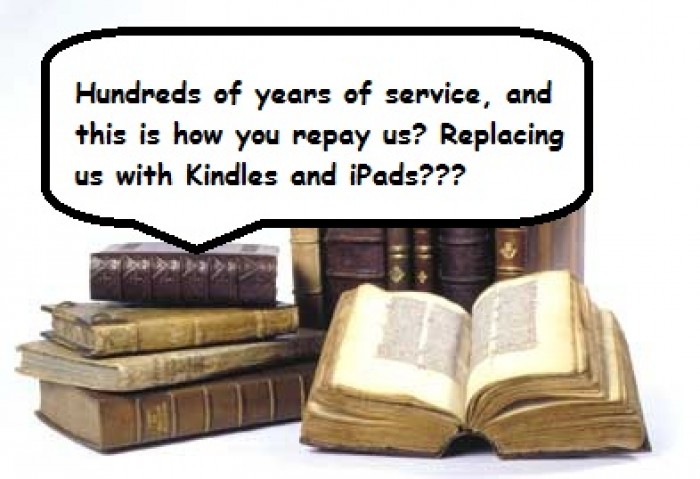
The two camps, the ereader-lovers and the ereader-haters, both make excellent points.  Ereaders provide portability (who wouldn’t want to download a new book minutes before a long flight?), flexibility (the idea of bringing along a whole bookshelf of books in one small, lightweight device is thrilling to an avid reader), and a whole new set of books designed only for an ereader. 

The haters are screaming about losing the physical book and its history, losing the smell and feel of a book in your hands, and losing the physical library or the physical bookshelf which gives so many people (myself included) happy, tingly feelings.

Clearly, the battle lines have been drawn.

Where am I amidst this passionate book lovers’ war?  I’m searching for middle ground.

I love books.  For my upcoming birthday (yikes…), my best friend made me a beautiful bookmark that proclaims me to be a bibliophile.  I accept that title proudly.  Not only am I a lover of books, I am a collector of books.  My favorite quote by Erasmus sums up my devotion: “When I have a little money I buy books…if any left over, I buy food and clothes”.  I fit this description perfectly; I bet if I added up the amount of money I’ve spent this year at Barnes and Noble and Amazon, on shipping for PaperBackSwap (got to ship books to get credits!), and at the used bookstore, it would be quite a bit more than what I spent on clothes.  I have three bookcases full of books; romances, general fiction, cookbooks, childhood books, I make no distinction in  the type of book I choose to save and what I sell or trade.  The only requirement to land it on my keeper shelf (er...shelves) is that I have or will read it at least twice. 

My book hoarding tendencies make ebooks very appealing.  One, ebooks tend to be cheaper (on some things, not everything) so I wouldn’t be spending as much as I do know.  Two, I love the idea of being able to download a book right then, right when I find it.  I hate reading a review at work, then either having to check to see if the library has it and put it on reserve, order it from PaperBackSwap, or try to find it at a real bookstore (I use online book shopping as a last resort).  It takes some work and if it’s something new, I’m pretty much guaranteed to only be able to buy it so why not by it ebook form?  And three, there are some really good books (especially romances) out there only being published as ebooks.  I would very much like to read them on something other than my computer or my phone. 

So, overall, ebooks seem like a great option for someone like me.  I should very firmly be on ebook-loving side of the war, right.  WRONG!

I’m still somewhere in the middle, probably screaming for someone to come rescue me at this point.

Why am I still in the middle?  Because some books are not meant to be read as an ebook.  Sometimes it is necessary (at least for this book hoarder) to have a copy (preferably a hardback copy, complete with dust jacket, if it comes that way) on the bookshelf.  Many books have sensory memories for me, and I wouldn’t trade the smell and feel of Deathly Hallows in my hands for anything.  I have certain books that I will never buy for my ereader.  Nora Roberts, certain Loretta Chase books, any YA fantasy series that requires me to read every book, in order, at least once a year (Harry Potter, Twilight, Narnia, The Hunger Games, you get the picture), and anything that continues or completes a series that I already have in print. 

Just because I'll soon be joining those with ereaders doesn’t mean I’ll be giving up the library.  I still plan to check out physical books, especially those that I want to read but have no intentions of ever reading again, and with the right ereader, I can also check out ebooks, which I find incredibly appealing. 

So here I am, firmly in the middle.  With the ereader Santa is bringing me for Christmas, I will be happily buying new books, but I will never forgo my lovely library and my much loved print books.  Sometimes a girl just needs a book to hold to make it all better.  :)

What camp are you in?  Or are you in the middle like me?

Wednesday, November 17, 2010

The Death of Library?

Yesterday, Andy posted his response to an article from ZDNet, that addressed the digital divide that could occur (and to some extent is occurring all ready) when libraries die due to everyone going all electronic and ebooks and ereaders taking over the world. While the digital divide is something interesting that should (and probably will) be addressed at another time, I want to focus on the first part.

Are libraries really dying?

Last summer I attended a session on Library 2.0 at the American Libraries Association's annual conference. One of the speakers brought up an interesting point about how the library is dying. At first, I really disagreed with him. Library stats are on the rise, especially in this not-so-great economy, right? People are discovering it's more economical to check out a book than to buy one, right? I read someplace the other day that libraries lend more movies than Netflix! So things are okay?

Well, if libraries are dying then doesn't that mean people aren't reading? One only has to look Amazon's revenue to know that isn't the case. Books are still being read, they are just being bought at low prices. Clearly, ebooks are becoming a huge market, because those numbers are pretty incredible. So if people are reading and watching movies, why are libraries on the decline?

The problem for libraries is that our society is lazy. We've gotten used to Amazon (or your choice of book vender) delivering the book to your front door or to your ereader. People aren't thinking they can hop over to the local public library to find an old movie to watch tonight; they prefer to wait for Netflix to drop in their mailbox rather than leave the house. No one thinks about the resources of your local public college or university, instead they jump on Google and find the Wikipedia page for whatever research they need to complete. Who is thinking that the library is a great place to go to find the latest Wii game?

If we step back for a minute and really think, circulation numbers are high enough that, even in the light of all this digital awareness and laziness, enough people are going to the library and taking advantage of all the free stuff. So libraries, at least the check-out-books-and-movies part of libraries, aren't going to die any time soon.

The real question is, however, is anyone using the library for information? Why go to the library and ask a reference librarian when you can find the answer to your question on Google? Why bother leaving your dorm room when everything you need to write your paper can be found online? Even in my hospital library, I see this. More often than not, my users do their searching via Google and then ask if I can find these really random obscure journal articles because that's the results Google yielded them. Instead of doing the smart thing and using PubMed (or even Google Scholar!), they are taking the easy path to information.

So what can we, as librarians, do to prevent the death of the library in the face of all the free online information (regardless of the quality) and sheer laziness that has taken over our society? Is the death of the library preventable or are we just waiting the inevitable?

I don't know the answer to this question. We've all been thinking about it, talking about it, and blogging about it, but no has the answer, and no one probably ever will until the end is upon us. Or we will never answer the question because the library is still alive and kicking.

Right now I believe the best option to prevent the death of our own libraries is to advertise what you have. Let the people in your community know what's out there and how they can take advantage of it.

Have a great collection of genealogy records that no one uses? Speak to a local group about sponsoring a "find an ancestor" day or something to that effect in your town. Publicize the event to the extreme via your website, your blog, your Twitter, whatever you use. Don't have an updated website, a person to blog, or a Twitter account? No fear, this is the perfect opportunity to establish one. But even the best websites, most insightful/informative blogs and Tweets go unnoticed if you don't advertise them. Make sure everything that carries your library's name on it has your website. Make sure your website is clearly labeled and consistently updated with news and events. Create a facebook page; anything to get your name out there and people in your library.

Tons of people don't use the public library because they don't know what's available to them. I bet there are a lot of people in your community who don't know they can check out video games or schedule a personal research consultation. They probably forgot that you have a ton of books/articles/magazines on job hunting, resume writing, and interviewing techniques. More than likely, there are a good number of elderly in the community who want to get online, but don't know how. They aren't aware that you teach (or could if you had enough people sign up) free classes about using the computer and the Internet.

Special and academic libraries have their own ways of advertising and attracting new users. They probably have less to worry about because someone has to stay around to order, pay, and organize all those electronic resources, but getting out into the community, whether it's a local community college, major research institution, law firm, hospital, or whatever (the possibilities are endless!), and promoting your services are the best way to get new people into the library while still continuing to provide excellent service to your current users.

Do you think the library is dying? What are you doing to prevent it?

LinkWithin

Related Posts Plugin for WordPress, Blogger...